
Templates
What Is a GoCardless Subscription Template?
A GoCardless subscription template is a reusable blueprint for a recurring subscription — you define the amount, frequency, currency, and description once, and GoCardless gives you a shareable link. Any customer who follows that link is taken through GoCardless’s own sign-up flow and automatically placed on the subscription you defined.
Subscription templates provide a way to set up multiple customers on the same recurring subscription, without having to create it individually for each customer.
A note on terminology: In the GoCardless dashboard, these are called subscription templates. GoCardless exposes them to third-party applications via an API resource called a Billing Request Template (BRT). The two are not the same thing — a subscription template is the concept you create and manage in the GoCardless dashboard, while a Billing Request Template is the underlying API record that WPdirectdebit reads. A simple subscription template corresponds to one BRT; a subscription template that includes a joining fee creates two linked BRTs (one for the mandate and subscription, one for the upfront payment). The WPdirectdebit Templates screen handles this mapping automatically.
How WPdirectdebit Uses Templates
While GoCardless subscription templates offer a useful way to get going quickly with subscriptions, they have some limitations. For example, you cannot customise notification emails, you have no way to add custom fields to gather related data, you cannot let customers amend the amounts or frequency of payments for themselves at sign-up time. Switching to WPdirectdebit subscriptions overcomes all of these shortfalls by leveraging the power of Gravity Forms and the WordPress universe.
WPdirectdebit is able to import the subscription templates you have created in your GoCardless account and lets you build a fully configured Gravity Form from each one — with a single click. It’s an incredibly fast way to get a working payment form onto your site, and it is especially useful when you already have an established plan in GoCardless that you want to replicate for new customers. WPdirectedebit also provides tools for bulk management of subscriptions created via this route.
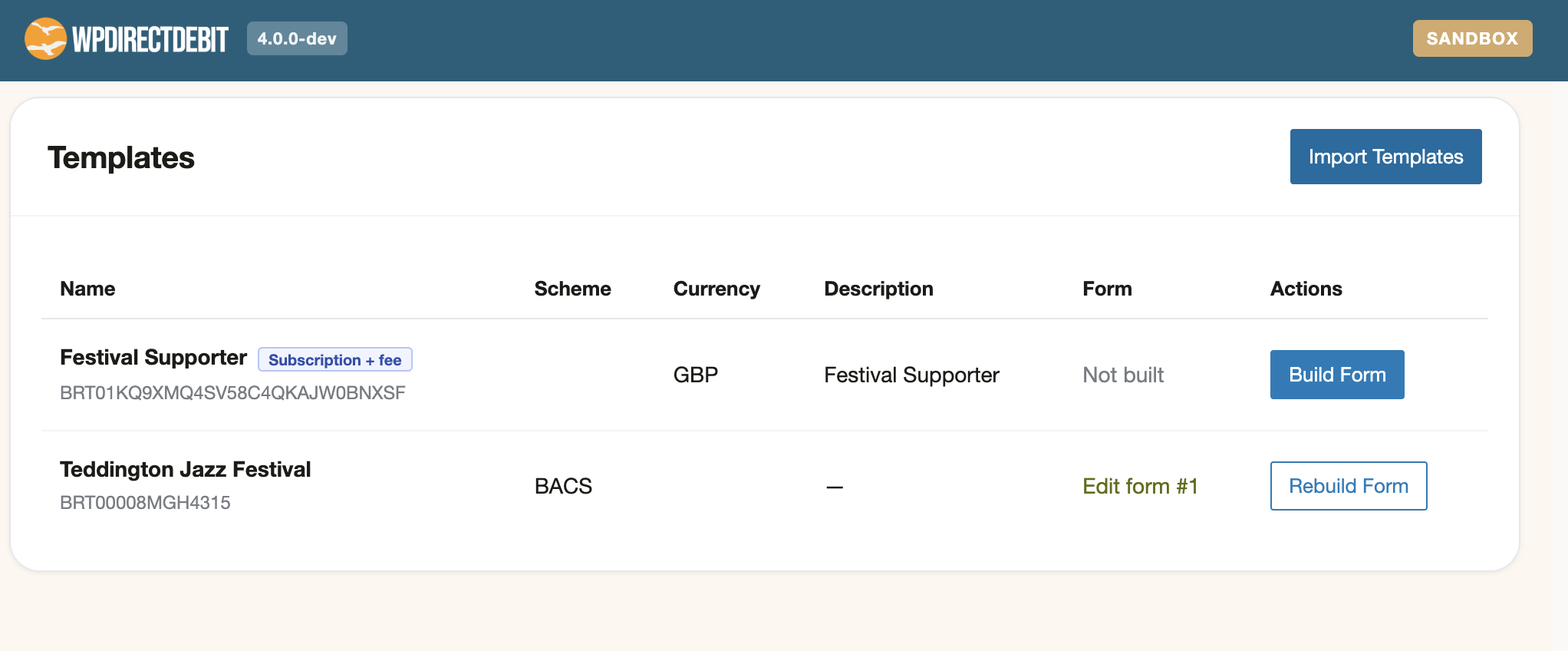
From the Templates screen in your WPdirectdebit settings, you can import a list of your GoCardless subscription templates. For each one listed, you can click Build Form to generate a ready-to-use Gravity Forms form and WPdirectdebit feed, pre-configured from the template's settings.
The generated form includes:
- A plan summary at the top of the form showing the plan name, subscription amount and billing schedule, and any joining fee
- Email address
- Name (first and last)
- Phone number
- Full address
- A payment amount field (visible to the customer), if an amount was specified
The field order matches the GoCardless customer flow — email is collected first, followed by name, phone, and address. All Customer Prefill mappings are wired up automatically — the customer's details from the form are passed to GoCardless without any further configuration. The form is given the title [WPDD] so it is easy to identify in your Gravity Forms list.
A WPdirectdebit feed is created at the same time, with the payment type, currency, mandate description, and subscription settings all set from the template and the options you select in the build modal.
Two email notifications are also created with the form. An admin notification is active immediately and sends a summary of each new sign-up to your site's admin address. A customer confirmation is created in a disabled state — review the message, personalise it if you wish, then enable it when you are ready to send it to customers.
Templates With a Joining Fee
When a GoCardless subscription template includes a one-off joining fee alongside the recurring subscription, GoCardless creates two Billing Request Template records with the same name — one covering the mandate and subscription, one covering the joining fee payment. As explained above, this is the normal way GoCardless represents a subscription template with an upfront component at the API level.
When a GoCardless subscription template is configured to collect both a recurring subscription and a one-off joining fee, GoCardless internally creates two Billing Request Template records sharing the same name — one for the mandate and subscription component, one for the joining fee payment. WPdirectdebit detects this automatically and merges them into a single row on the Templates screen, so you see one entry per plan rather than two – analogous to the way GoCardless represents subscription templates in the GoCardless dashboard.
When you open the build modal, the joining fee amount and description are pre-filled from GoCardless. You can adjust these values before building if needed. The generated form and its WPdirectdebit feed are configured to collect both the subscription and the upfront joining fee in a single customer journey.
Suggested Settings
When you open the build modal, WPdirectdebit checks your active GoCardless subscriptions and looks for any that match the template by name. If it finds a consistent match — where all sampled subscriptions on that plan share the same amount and interval — it pre-populates the amount, schedule, and preferred collection day fields in the modal for you. You can accept or adjust these values before building.
The collection day is read from each subscription’s scheduled collection date. For BACS subscriptions, GoCardless does not store a separate day-of-month field — WPdirectdebit infers it from the subscription’s start date instead.
If no matching subscriptions are found but the template has a fixed payment amount, that amount is suggested instead. Where subscriptions exist but vary in amount (for example different customer tiers on the same plan), the amount field is left blank for you to complete.
Note on subscription amount for templates with a joining fee: GoCardless subscription templates do not expose the recurring subscription amount through the API — only the joining fee amount is directly available from the template data. If the build modal cannot find a matching active subscription to infer the amount from, the amount field will be blank and a prompt will direct you to check your GoCardless dashboard. This is a GoCardless API limitation.
Subscription data is cached for fifteen minutes to avoid repeated API calls. Clicking Import Templates always fetches fresh data and clears this cache, so if you have just added a subscriber you can click Import Templates to pick up their details immediately.
Rebuilding a Form
If a form has already been built for a template, the button changes to Rebuild Form. Rebuilding creates a fresh form and feed — useful if you need to update the settings, for example if the subscription amount or interval has changed.
When you rebuild, the previous form is unlinked from the template but is not deleted. All existing entries on that form are preserved. The old form remains in your Gravity Forms list and you can delete it manually once you are satisfied that no entries need to be retained.
How WPdirectdebit Forms Compare to GoCardless Subscription Templates
WPdirectdebit template-based forms serve the same purpose as GoCardless subscription templates — getting multiple customers onto a standard recurring plan — but they work differently in several important respects:
| GoCardless subscription template | WPdirectdebit form |
|---|---|
| Has its own authorisation URL — customers can use it directly without visiting your website. | Customers go through a form on your website — you control the page, the branding, and the surrounding content. Instead of sharing the template URL, you’d simply share the ULR of the webpage where the form is displayed. |
| A self-contained flow with no connection to the rest of your business. No notification emails, no CRM sync, no consent recording, no marketing integration. | Fully integrated with WordPress and Gravity Forms. Send branded notification emails to merchant and customer, record consent, sync to your CRM or email platform, trigger automations, and connect to hundreds of Gravity Forms add-ons — all from the same sign-up that takes the direct debit payment. |
| Fixed fields — the GoCardless drop-in collects name, email, address, and bank details only. | Fully extensible — add any Gravity Forms fields, conditional logic, consent checkboxes, file uploads, and more. |
| Changing the amount on a GoCardless subscription template updates future payments on all subscriptions linked to that template. | Changes to the form do not affect existing subscriptions; only new ones. Use WPdirectdebit’s bulk price update tool to update amounts on WPdirectdebit-created subscriptions. |
| Managed entirely in the GoCardless dashboard. | Managed in WordPress — you can edit the form, configure notifications, set up confirmations, and embed it anywhere on your site. |
| Mandates and subscriptions created via a GoCardless subscription template are owned by GoCardless — no other app, including WPdirectdebit, can modify or cancel them via the API. Manual changes are still possible through the GoCardless dashboard | All mandates, payments, and subscriptions created through WPdirectdebit are owned by the WPdirectdebit app — only WPdirectdebit can bulk-manage or cancel them via the API. You can still make manual changes (for example editing a subscription amount) through the GoCardless dashboard, but not in bulk. For this, use WPdirectdebit’s bulk price update tool. |
Using Templates for Bulk Changes
Because a single WPdirectdebit form can be used by any number of customers, it behaves in a similar way to a GoCardless subscription template for onboarding new sign-ups at scale. All new customers go through the same form — any change you make to the form or its feed immediately affects everyone who signs up from that point on.
This makes templates a practical tool for managing plan changes. If you increase a subscription price or change the billing interval, rebuild the form from the template, update the amount in the build modal to match, then swap the embedded form on your website to the new one. Only new customers signing up via the new form will be placed on the revised plan.
For changes that need to apply to existing subscribers, WPdirectdebit includes a bulk subscription management tool. From the Subscriptions screen you can update the price, pause, or resume all subscriptions that share a given name — which is the name GoCardless records when a subscription is created through a form feed. This means every subscriber on a particular plan can be updated in a single operation without touching the GoCardless dashboard or writing any API code.
Important — app ownership: GoCardless enforces strict ownership at the API level. An app can only modify resources it created. This means WPdirectdebit can only bulk-manage subscriptions that were created through WPdirectdebit — not subscriptions created via GoCardless subscription templates, the GoCardless dashboard, or any other integration. If you have existing customers who signed up through a GoCardless template or another tool, their subscriptions sit outside WPdirectdebit’s reach and must be managed directly in GoCardless. This is one of the key reasons to move new sign-ups onto a WPdirectdebit form rather than continuing to use the GoCardless template URL: every new customer who goes through a WPdirectdebit form will have their subscription owned by WPdirectdebit, and therefore manageable in bulk.
When you trigger a bulk price update, WPdirectdebit fetches every active or paused subscription in your GoCardless account that matches the name, skipping any that do not have a scheduled upcoming payment (since those cannot be amended). Bulk pause lets you halt subscriptions indefinitely, for a set number of cycles, or until a specific date — the correct number of cycles is calculated automatically for each individual subscription. Bulk resume reactivates paused subscriptions matching the name.
Because a large account may have hundreds or thousands of matching subscriptions, the operation runs in chunks of fifty subscriptions at a time. API calls are throttled to avoid hitting GoCardless rate limits, and if a rate limit response is received the job pauses automatically before retrying. You can track progress on the Subscriptions screen while the job runs.
WPdirectdebit identifies the subscriptions it owns by writing a metadata tag to each GoCardless resource it creates. This is controlled by the Write plugin metadata to GoCardless resources setting in the GoCardless Settings panel of WPdirectdebit, which is enabled by default. With this setting on, bulk operations filter automatically to only subscriptions carrying the WPdirectdebit tag — which in practice is the same set GoCardless would permit the plugin to edit, but it avoids making API calls that would fail and allows the Subscriptions screen to clearly distinguish plugin-created subscriptions from any others in your account.